◈
Player-Owned Assets
Eligible game items, virtual land and digital avatars can use standardized NFT contracts to record ownership on-chain.
AetherPlay Coin (APC) integrates AIGC content generation, XR immersive interaction, on-chain digital assets, cross-chain interoperability and DAO governance to build a player-created, player-owned and community-governed virtual ecosystem.
Traditional virtual worlds often keep maps, characters, items, user data and economic activity inside closed platform databases. APC proposes a more open structure where eligible digital assets can have verifiable on-chain ownership and players can participate in creation, governance and ecosystem development.
AetherPlay combines AI-assisted content production, standardized digital-asset infrastructure and community participation to reduce content-production barriers while expanding ownership, composability and long-term ecosystem participation.
Eligible game items, virtual land and digital avatars can use standardized NFT contracts to record ownership on-chain.
AIGC tools lower barriers for maps, stories, characters and interactive content while human creators retain governance roles.
AI supports large-scale content generation and dynamic orchestration for living, continuously expanding virtual worlds.
Standardized contracts and audited cross-chain infrastructure can connect eligible assets across applications and networks.
DAOs and guilds provide proposal and voting mechanisms designed around transparency, verifiability and risk control.
Integrating AI, immersive interaction, blockchain infrastructure and decentralized governance into a modular foundation for an open virtual ecosystem.
AI modules assist in generating maps, quests, stories, characters, environments and dynamic events, while human teams govern world-building, rules and safety review.
Progressive support for VR, AR and spatial-computing experiences such as concerts, digital galleries, social spaces and immersive games.
Standardized NFT contracts can record ownership of eligible in-world assets while application rules and legal documents define the specific rights attached to them.
Infrastructure is designed to expand across major public blockchains using audited bridge or messaging solutions based on security, liquidity and ecosystem needs.
Governance structures use proposals, voting, thresholds, permission management and security controls to support transparent community coordination.
APC is designed as the ecosystem governance and utility token, while APU is planned as an in-game consumable token generated through compliant ecosystem activity.
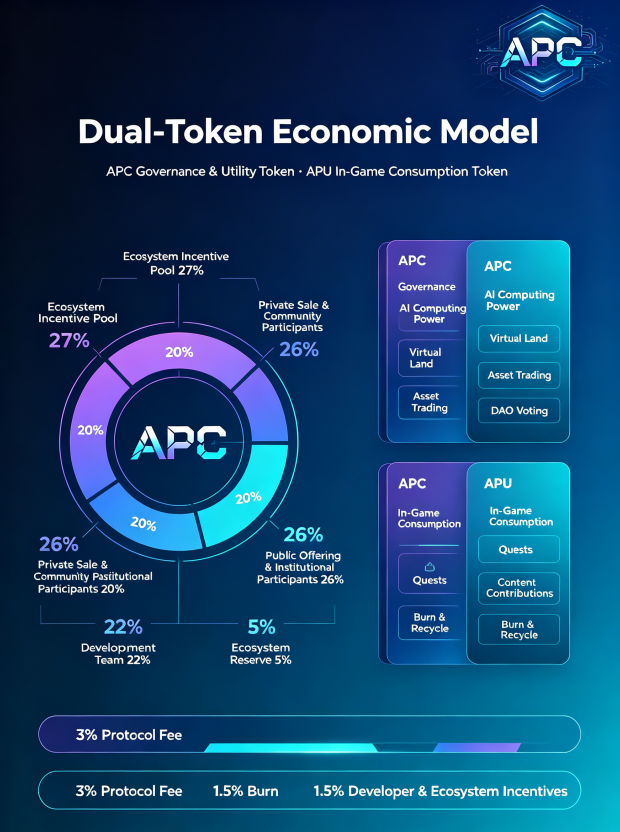
Reference visual from the APC whitepaper materials, integrated into the website tokenomics section.
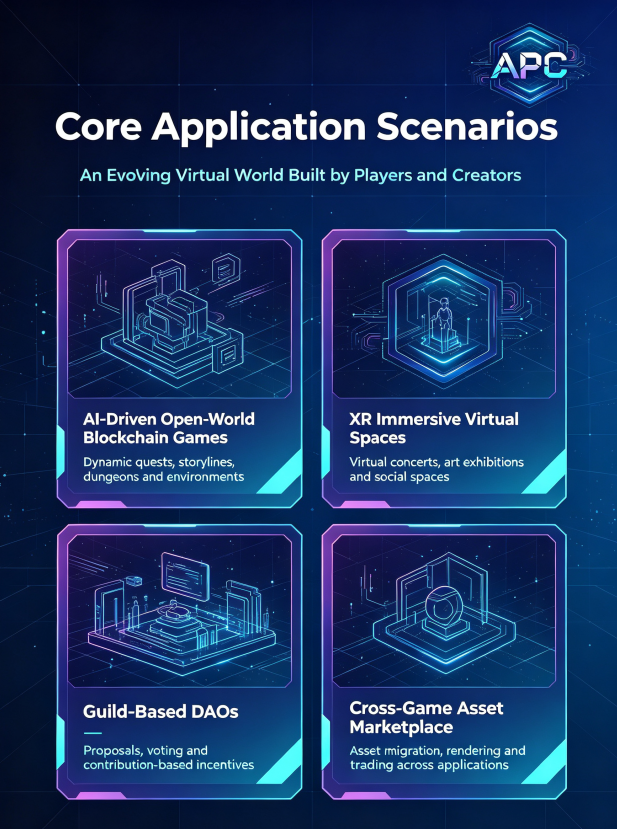
APC’s proposed application layer connects AI-generated experiences, immersive spaces, community coordination and composable digital assets.
AI can dynamically generate quests, storylines, instances and environmental content based on world settings, rules and player behavior.
Dynamic content • Player behavior • Open-world growthThe ecosystem may expand into virtual concerts, digital art exhibitions, brand spaces, social environments and immersive entertainment.
VR/AR • Social spaces • Digital identityPlayers may organize around gaming, creation, competition or community building and participate through proposals and voting.
Proposals • Voting • Contribution incentivesSubject to technical standards, licenses and game rules, eligible assets may be migrated, displayed or traded across multiple applications.
Composability • Trading • InteroperabilityThe application layer is designed to connect creation, experience, governance and asset mobility without forcing every game to use exactly the same economic model.
A staged path toward a more interoperable, immersive and autonomous virtual ecosystem.
AetherPlay envisions next-generation virtual worlds as open digital economic networks jointly built by players, creators and developers. AIGC lowers content-production barriers, standardized contracts establish verifiable asset records, DAOs enable community governance, and cross-chain infrastructure connects applications into a broader ecosystem.
“A world where imagination, ownership and participation can create lasting digital value.”
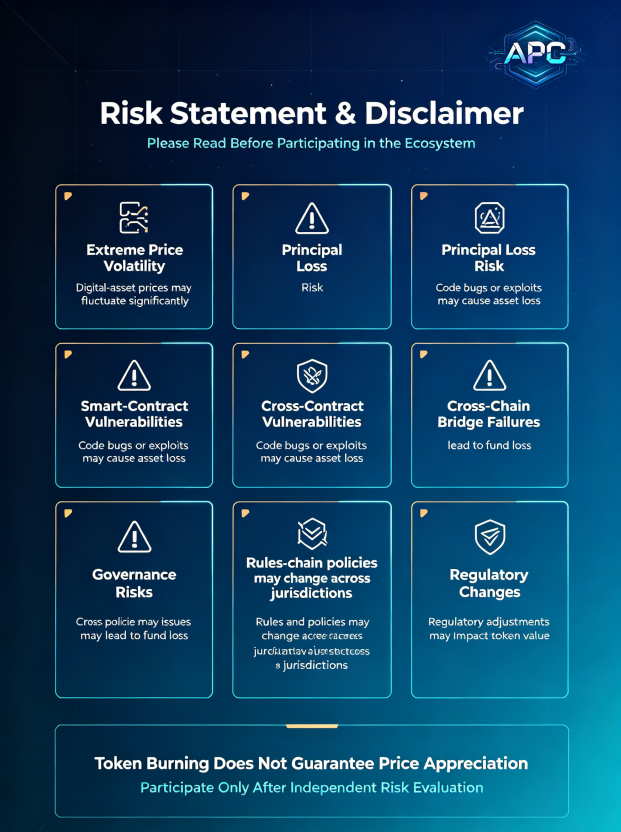
The project plans to use on-chain transaction records, smart-contract audits, risk monitoring and necessary KYC/AML procedures while adapting participation rules to applicable legal requirements across jurisdictions.